
Article from Fidelity, an ESI Strategic Partner:
Positive catalysts amidst the conflict in Iran: Delayed, more volatile, not derailed
Understanding the impact of global tensions on equity markets and trade
What we are watching
Volatility rises, fundamentals hold
A significant theme that began in 2025 and continues today is the broadening of global economic growth and equity market leadership. For much of the previous cycle, U.S. large cap growth stocks dominated—but in the new market regime, U.S. small and mid cap equities, international equities, and commodity producers have become increasingly attractive. This is a theme we see continuing despite geopolitical turmoil and conflict. Geopolitical tensions may increase volatility; and they may delay equity market broadening—but they likely won’t derail it.
We will take a closer look at the broadening equity markets trade in the weeks ahead. This week we will focus on the unease investors may feel—and the opportunities they may overlook—when volatility rises due to major geopolitical events. Conflicts such as the current U.S./Israeli–Iran battle often produce sharp bouts of volatility in global markets. Past events in the region have typically resulted in temporary sell-offs followed by relatively strong rebounds as risks fade and fundamentals reassert themselves. These patterns are rooted in the market’s tendency to overprice risk during crises, creating opportunities for disciplined investors to buy quality assets at attractive valuations.
The recent jump in oil prices has underscored the market’s sensitivity to developments in major energy-producing regions. While these episodes can be unsettling over the short term, history shows that such disruptions could create buying opportunities for long‑term investors (Exhibit 1).
A key factor regarding the current conflict is its expected duration and how widely its effects could spread. If the conflict persists and the Strait of Hormuz—critical for the transportation of global oil and liquified natural gas—remains effectively closed, fluctuating energy prices could slow spending and undermine U.S. consumer confidence. In such an environment, the broadening of economic growth and markets might be slower and bumpier, but for now many parts of the economy—and corporate fundamentals—are holding up well.
Chart spotlight: Almost a century of market shocks—and what happened next
Recent analysis by Denise Chisholm, Fidelity’s director of quantitative market strategy, concluded that a broad, aggregated set of geopolitical shocks from Pearl Harbor through the 2022 Russia–Ukraine invasion resulted in an average equity return over the following 12 months of about 8% (right around equities’ long-run annual average). The data signals that historically most geopolitical shocks rarely derail long‑term equity returns.
Exhibit 1: Stock market performance following major geopolitical shocks (1942–2026)
(Next 12-month returns, S&P 500)
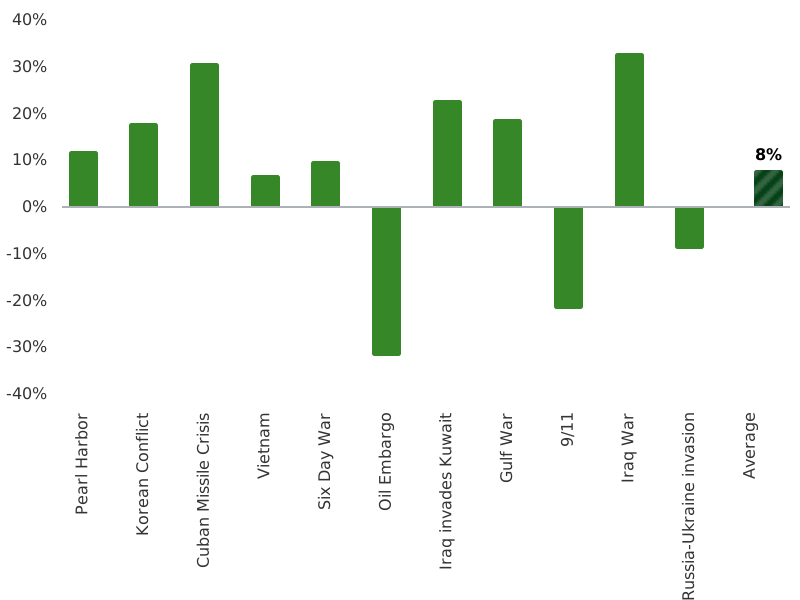
Past performance is no guarantee of future results. Analysis is based on the S&P 500 index. Next 12-month returns: The percentage gain or loss an investment is expected to generate over the next 12 months. Data analyzed monthly from 1942 through January 2026. Sources: Haver Analytics, FactSet, Fidelity Investments, as of 3/2/2026.
But is the energy crisis in the 1970s a fair parallel for today?
You may notice the 1973–1974 oil embargo/energy crisis in the chart above and think it seems similar to what is happening now. However, that moment in economic history was extreme: Oil prices soared because of OPEC’s total embargo targeting many nations, including the U.S., the United Kingdom, Canada, and Japan. Global oil supply was squeezed in a united effort, which is not the case today. Economies around the globe suffered from high inflation, job losses, and recession. While the current U.S.-Israeli conflict with Iran has caused oil prices to spike and increased market volatility, its overall consequences are likely to be less severe because modern oil sources are more diverse, strategic reserves exist, and policymakers have better tools to respond.
Another way the crisis in the 1970s was different: Today, U.S. households spend about 3% of their income on energy, compared to 8%–9% in the 1970s. So, even if oil prices rose by a similar percentage now, it would take a smaller bite out of consumers’ income and impact the U.S. economy less than it did in the past.
However, if the conflict drags on, and oil prices remain high, it could eventually cause higher overall inflation that spreads into other economic sectors. In addition, the 1973 embargo drove crude prices up, boosting oil company values and profits so much that energy became a cornerstone of the S&P 500 index by the end of the decade. Today the sector makes up about 3.5% of the S&P 500,1 reflecting the rise of tech firms and the shift away from fossil fuels as market leaders.
Staying steady through volatility
S&P 500 companies’ earnings are projected to grow by 15% in 2026.2 If oil shocks are brief, economic expansion should withstand price spikes, and equity markets may revert to fundamentals unless the conflict worsens. Thus, unless the Iran situation escalates and/or extends, the broadening of equity market leadership may be delayed, there may be volatility in the interim, but wider market growth is unlikely to be derailed.
We believe that periods of volatility can be uncomfortable, but they can also create opportunities for long‑term investors who stay disciplined with diversified, well‑structured portfolios. Keeping exposure steady, rebalancing across regions and sectors, and thoughtfully using alternatives can help manage risk while positioning portfolios to participate when market leadership broadens again.
TC8828642(0326)1